
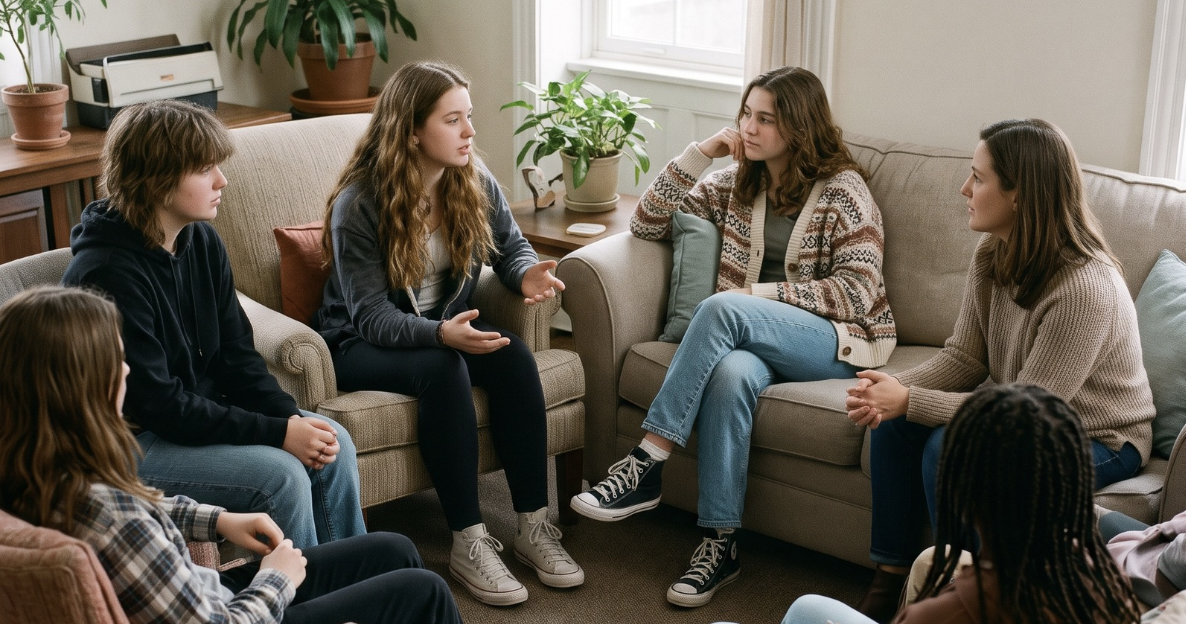
Navigating overwhelming stress often leaves teens feeling isolated from the people around them. When emotional distress builds up, adolescents might assume that nobody else understands the heavy weight they carry. Sitting in a room with peers who face similar challenges can shift that perspective. Group therapy offers a supportive, structured environment where teenagers learn that their struggles and past hardships do not make them odd or alone.
Guided group sessions create space to rebuild trust and practice clear boundaries at a comfortable pace. These shared conversations allow participants to process difficult emotions without feeling put on the spot. Over time, seeing peers share vulnerable thoughts encourages individuals to talk about their own experiences.
Core Frameworks That Build Safety
Effective group sessions prioritize choice and emotional security so that no teen feels pressured to disclose personal history before feeling ready. Facilitators often utilize expressive exercises, like storytelling or art, to help participants process heavy themes gently. These nonverbal approaches provide an alternative outlet when putting complex feelings into words feels too taxing.
Skill-building exercises give adolescents practical tools they can use during overwhelming moments. Practices adapted from Cognitive Behavioral Therapy (CBT) and Dialectical Behavior Therapy (DBT) help participants stay grounded when stress arises.
Wise mind practice: Balancing intense emotions with logical facts during stressful situations.
Safe boundary setting: Practicing clear communication and personal space in a supportive peer group.
Grounding techniques: Using physical awareness and sensory focus to ease sudden anxiety.
Research on group treatment models shows that structured peer environments lower feelings of stigma while helping adolescents build practical coping skills during challenging life events. This environment allows teens to watch others test out new responses, making personal growth feel far more approachable.
Practical Group Approaches for Daily Growth
Wise Mind Circles for emotion regulation: Helps adolescents pause before reacting when feeling overwhelmed.
Guided peer dialogue for trust building: Allows teens to practice setting clear, respectful boundaries.
Expressive arts for stress processing: Offers a nonverbal outlet to explore complex feelings safely.
Working through distress can make daily social interactions feel intimidating or exhausting. Participating in structured group activities allows young people to practice relational skills in real time. As teens observe their peers navigating similar struggles, they gain fresh perspectives on their own capabilities.
How Group Therapy Works at Eva Carlston Academy
Group therapy forms an integral part of each healing journey at Eva Carlston Academy, where girls participate in specialized peer groups tailored to shared life experiences. Beyond traditional discussion, students engage in expressive arts and weekly art therapy groups in a fully equipped studio.
These structured sessions extend beyond clinical spaces into experiential activities around Salt Lake City. Students collaborate during Saturday art workshops, outdoor recreation, and community projects, turning therapy concepts into practical habits. By blending structured group work with creative outlets, girls build confidence and develop authentic connections with those around them.
A Supportive Path Forward
Finding the right support system can transform how adolescents process emotional challenges and view their future. Group therapy provides a balanced space to practice new coping skills while building lasting connections. When teens realize they do not have to carry their burdens alone, healing becomes a shared journey.
References
National Institute of Mental Health. Child and Adolescent Mental Health. (2024).
Substance Abuse and Mental Health Services Administration. Trauma-Informed Care in Behavioral Health Services. (2023).
Washington State Department of Social and Health Services. Applying Trauma-Focused Cognitive Behavioral Therapy in Group Format. (2018).