
Music often arrives before language. A familiar voice, a chord progression, a bass line that settles the body without asking for permission. Sound shapes attention and emotion quickly, sometimes faster than conscious thought.
That influence also reaches beyond listening. Music is received, and it is made. Listening shifts state through something external, while playing or creating adds agency through breath, hands, and timing. Together, those experiences offer a practical way to organize emotion, communicate what feels hard to say, and stay connected to identity as it evolves.
Sound as a nervous system cue
Regulation is the body’s ability to move between states like alert, calm, connected, and rested, then return toward balance after stress. Music supports those shifts because sound is processed fast across systems tied to emotion, threat detection, reward, and body cues like heart rate, breathing, and muscle tone. Music reaches meaning and physiology at the same time.
Research on music listening shows measurable effects on the stress response. In a well-known study, listening to music before a standardized stressor was linked with faster autonomic nervous system recovery, while hormonal stress changes were smaller. People often describe the shift as a settling feeling, as arousal comes down and the body returns toward baseline more efficiently.
The music someone reaches for influences what happens next. Familiar music cues predictability and safety, while new music invites focus and curiosity. Volume, tempo, and lyrics move the system toward activation or toward downshifting, depending on the person and the moment.
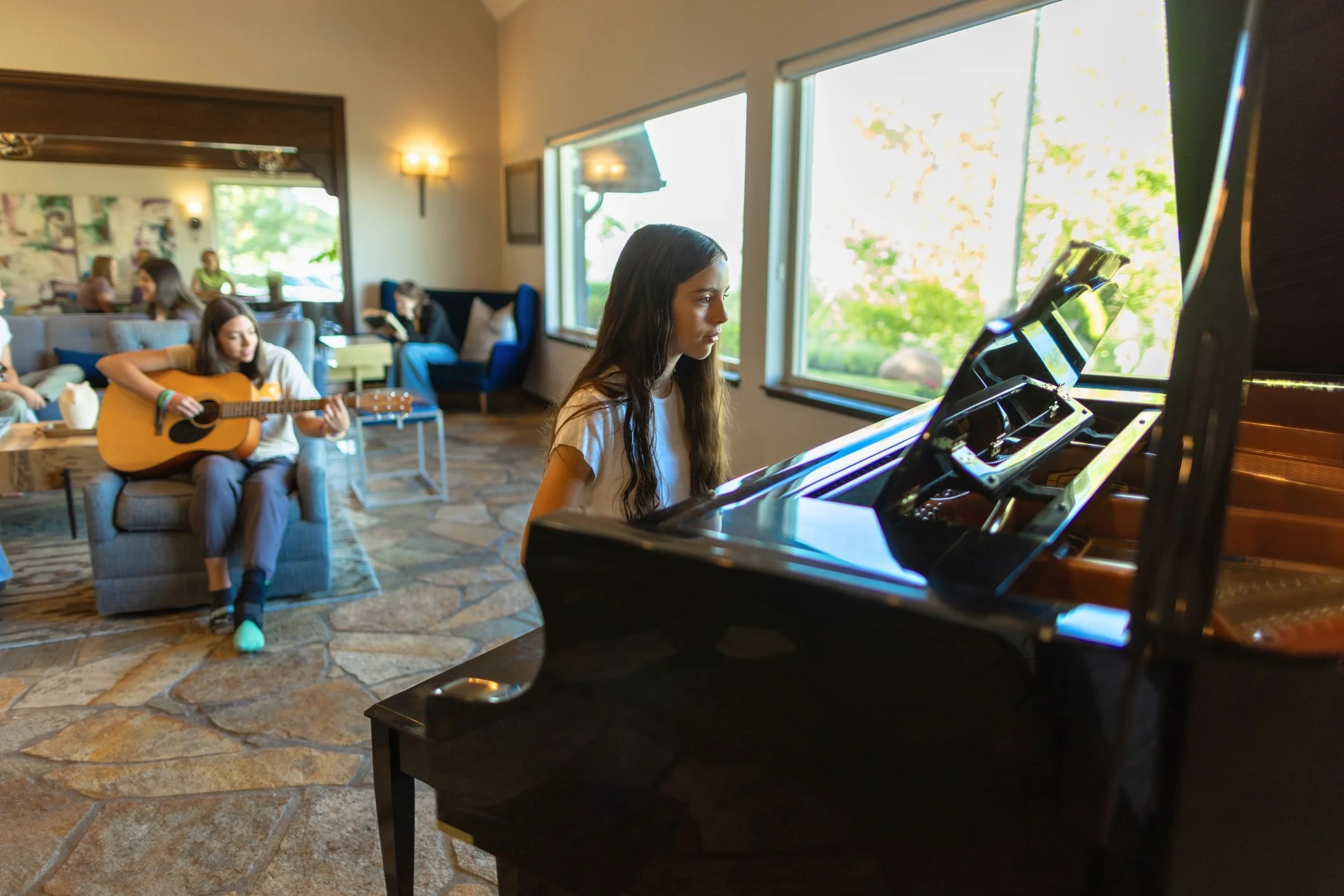
Music-making adds another layer through coordination and structure. Singing and instrument play use breath and posture alongside fine-motor control, and practice builds patterns that steady attention. For some people, the shift comes from sound itself. For others, the shift comes from the arc of the experience, with a beginning, a middle, and an end the body anticipates.
How music communicates emotion
People often reach for music when experience outpaces vocabulary. A song holds nuance, carries two emotions at once, and gives form to a feeling that stays hard to explain. Listening brings emotion close enough to recognize it clearly, while also creating enough distance to observe it without getting swept away.
This helps explain why playlists feel personal. A sequence of tracks communicates an inner state without a long explanation. The order carries meaning too, with songs that help someone arrive, release, reset, or reconnect. Even when a listener cannot name the pattern, the body often responds to it.
Creating music turns that same emotional material into choices. Writing lyrics, shaping a melody, sampling sounds, or learning a chord progression transforms inner experience through decisions about repetition, change, and resolution. Improvisation works in real time, as the hands find a phrase and the brain follows, with the music holding what speech struggles to carry.
In clinical settings, music therapy builds on these pathways with support from a credentialed professional. Listening, songwriting, improvisation, and instrument play become structured ways to express and process emotion, especially when the starting point is sensation or mood rather than a clear narrative.
The self inside the soundtrack
Identity forms through stories, relationships, and values, and music becomes one of the markers. Songs attach to phases of life, friendships, and turning points. Over time, certain artists or genres become shorthand for personal history, including what someone needed in that season and what helped them move through it.
Music also reflects what someone seeks right now – comfort, energy, clarity, connection, solitude. Lyrics offer language for beliefs and boundaries, while instrumentals carry what stays harder to name. Even small preferences become meaningful, like returning to the same album during transitions or reaching for specific sounds when focus starts to drift.
The way someone engages with music offers clues too. Some people compose. Some practice an instrument. Some perform with others. Some keep listening private. Those patterns shift across seasons of life, and the shift itself often tells a story.
For teens, this identity layer becomes visible in simple, concrete ways. Music signals belonging, differentiation, and values before a teen wants to explain them. Curiosity tends to land best when it stays light and specific, with questions like “What has been on repeat lately?” or “What changes after a hard day?”
Music at Eva Carlston
Eva Carlston Academy treats creative work as a core language alongside therapy and academics. Our focus on fine arts gives students a place to express themselves, process emotion, and explore identity, with creative expression woven into learning and daily life.
Music fits naturally inside that approach because sound bridges the gap between feeling and language. In music therapy, students use non-verbal, sound-based expression to access and communicate their inner state, and the focus stays on communication rather than performance. This may take the form of songwriting, guitar work that ranges from simple to sophisticated, drumming patterns, or other forms of music-making that support expression in the moment.
Within that frame, listening supports regulation, and creating gives shape to experience. Over time, those experiences help students notice patterns, preferences, and parts of self that deserve space, including what shows up in the quiet after the song ends.
Sometimes the clearest next step is simple: return to sound, and let it help make sense of what the day left behind.
References
Thoma, M. V., et al. The Effect of Music on the Human Stress Response (2013).
Chong, H. J., Kim, H. J., & Kim, B. Scoping Review on the Use of Music for Emotion Regulation (2024).